
I was at Salesforce Dreamforce last week. It’s impressive to see a conference and company run that long – continuing to reinvent itself. Marc Benioff is one of the great tech CEOs with real values – he has always wanted to improve the world, and that feeling is imbued in the company and culture. He does it in a particular way: by bringing people together.
This last week was the most live time in debate about AI – the question of whether there should be a pause in development, whether it is an existential risk. The leaders of the companies that make AI had opinions, expressed them, even though they varied. And it just so happened that a number of those leaders were at the Dreamforce conference – with Dario Amodei, Sam Altman, and Jensen Huang among others all visiting and discussing.
I was a speaker at Dreamforce too, and I am often called to speak about the intersection between nuclear energy and AI. I shared my live takes from the stage. In the buildup to that, I tried to write my position: “this is what I believe about AI”. I wrote many versions of that, but felt unsatisfied. It was unfinished, not the final version. But what I was prepared to do was talk about it. In conversation with the moderator and audience. Conversation was the right medium. When we have a difficult issue, there is no one opinion, one answer, that is the only solution. A quote I like from my grandfather when explaining how they studied theoretical physics at the Institute for Advanced Study was: “What we don’t understand, we explain to each other.”
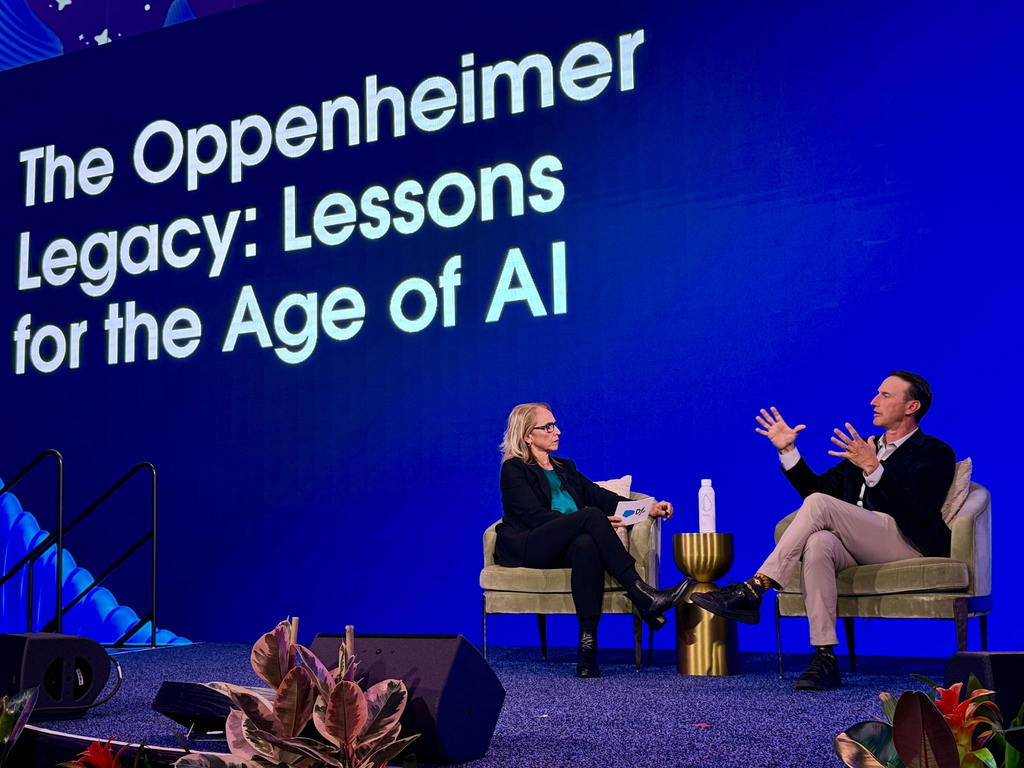
Dialog is what I saw that happening this last week. There is a dividing line in the debate: the founders and leaders who saw this coming – and made the AI boom happen believed it could pose a threat, at least in the “normal order” of business such as jobs and employment – but in the extreme – and existential threats that could arise – have different onions. The leaders who helped usher this AI age in and have generated huge success are waring us that they have an insight into potential threats. That’s compelling to me. I think there are many times scientists and technologists have insight into what a technology can do that others like journalists and politicians don’t – it is important to listen to them.
But Jensen Huang, who made this technology as much as the others, has a different opinion. He says a couple of things that really resonate with me: this is not magic. It is not science fiction – there is no monster that rises up and does stuff we don’t control – it is engineering. The science fiction narrative is strong – but he didn’t grow up with it and doesn’t naturally believe the Terminator will come. He’s also said something in the recent past that really resonated with me: “If you believe that there is a threat in this technology, then you need to start with dialog – talk to the other side.” His set of opinions has a very high resonance with me: I personally have a gut reaction that is not fear of AI, and to the extent that a technology has existential risk – the only path to safety is dialog with your perceived enemies. That is our lesson from the nuclear arms race.
Jensen Huang was referring to China at the time. But the same could be said about AI rivals. A huge breakthrough from last week that directly preceded the Dreamforce conference: Dario, Sam Altman, and Elon Musk made public statements of agreement – from parties that are much more likely to spar in tweets, lawsuits, and business competition. Their agreement actually triggered a bit of a backlash from those accusing these parties of bad faith: they are suggesting a pause and regulation as a way of regulatory capture, and to prevent other parties from getting in the game and attack open source. There is low trust and lots of opinon in the analysis of this fast-moving topic.
Not one of these people’s opinions and power to affect change – both of which they have lots of – is the answer. It is the messy intersection of all of them.
Which brings me back to Dreamforce, and Marc Benioff. Some people bring others together. Marc does that for a living – bundled up as a software company and a business model. And this is a rare time when the tech leaders of the world can set the example for the entire world. These topics are so important that the tweets of business leaders are reacted to by presidents and leaders of the most powerful countries in the world. And unlike the fission race, the AI race is being driven by private capital.
During my small piece as a speaker, kind of puzzling and bumbling out what should be done – the best I came up with is – “I guess I should invite them out to dinner and talk about it.” Learned that from Marc – so he is certainly first on the list.
We don’t have to have all the answers, but what we don’t understand, we can explain to each other.