
A 40-year-old lesson about the courage to have dialogue.
By Charles Oppenheimer & Lucas Ruiz
Forty years ago, on September 15, 1986, Soviet leader Mikhail Gorbachev dispatched Foreign Minister Eduard Shevardnadze to attend the United Nations General Assembly in the United States. Unbeknownst to officials in Washington, Shevardnadze carried a private letter for President Ronald Reagan. Gorbachev was concerned by the lack of progress in arms control negotiations between the nuclear superpowers since their Geneva Summit in 1985 where they jointly declared “a nuclear war cannot be won and must never be fought.” He reasoned “that the negotiations need[ed] a major impetus,” and proposed “a quick one-on-one meeting… in Iceland or in London… to demonstrate political will.”
Reagan agreed.
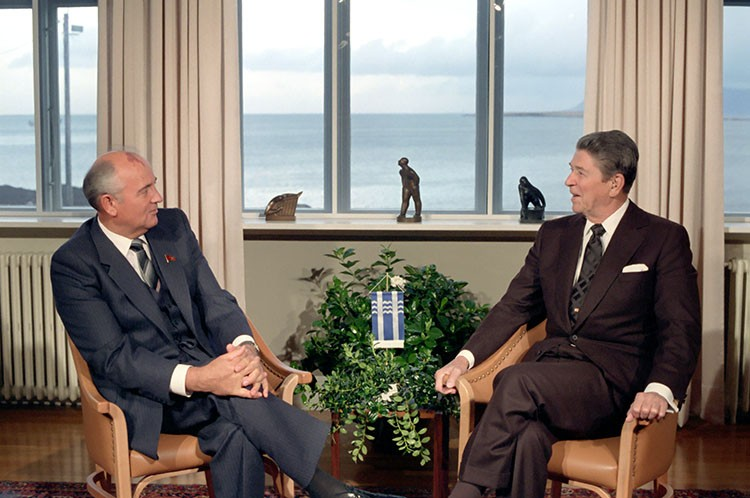
Less than a month later, the two heads of state convened two marathon days of meetings in Reykjavik. Although neither party had expected an agreement from the discussions, they nearly achieved the most ambitious deal for nuclear disarmament the world has ever known. While on his return flight to Moscow, Gorbachev reflected that “Reykjavik led us to the most important stage of understanding… Everybody saw that agreement [was] possible.” Indeed, he believed both parties “drew the conclusion that the necessity for dialogue [had] increased even more.”
From Dialogue to Reduction
Reykjavik provided an essential lifeline to the most consequential relationship of the Cold War during one of its tensest moments. Fourteen months after the meeting, in December 1987, Reagan and Gorbachev signed the Intermediate-Range Nuclear Forces (INF) Treaty. It helped open the way to the Golden Age of arms control when global nuclear stockpiles were reduced by roughly 80% from the peak of 70,374 in 1986 to an estimated 12,187 today. None of this might have happened had Reagan and Gorbachev not had the courage to engage in leader-to-leader dialogue.
Today, the overall inventory of nuclear weapons continues to shrink, albeit much more slowly and with diminishing returns.
The relatively small reductions occurring today are happening only because Russia and the United States continue to dismantle the warheads they previously retired while the size of their military stockpiles remains unchanged. However, the expiration of New START in February 2026 has left each arsenal unconstrained by a numerical limit of any kind for the first time since May 1972.
Individually, each already has the ability to unleash catastrophic harm on the world. Together, they could bring about human extinction. Neither risk is acceptable and yet each party may be on the verge of increasing its respective stockpile for the first time in decades.
Expanding the Negotiating Table
In September 2026, Chinese president Xi Jinping made his first state visit to the United States during President Donald Trump’s second term. The White House readout from the meeting stated that Trump “advocated for trilateral arms control negotiations between the United States, Russia, and China.” Although the Chinese readout made no such mention, this would not be the first time the American president has expressed this sentiment in such a setting.
His concern is not unfounded: the Chinese arsenal has grown considerably in recent years. According to the latest estimates China now possesses around 600 warheads, firmly placing it in a middle tier between the nuclear superpowers – the U.S. and Russia – and the lesser powers. The U.S. Department of Defense has estimated the Chinese may continue to increase their stockpile beyond 1,000 warheads by 2030, but that is far from certain.
Regardless, the growth of the Chinese arsenal has disrupted the bilateral character of nuclear arms control. Moscow has long argued that a strictly bilateral framework ignored the British and French forces it considers a threat, but Washington has traditionally kept them off the table, preferring to keep negotiations bilateral.
Now Washington faces a version of the dilemma it once dismissed, while Beijing maintains that the two largest arsenals must shrink before it can join any limits. Each capital can point to the others as a reason to wait. Advocating trilateral talks in a readout is a beginning, but it is not yet dialogue. The likeliest path to bringing Beijing to the table may run through deeper US-Russian cuts toward China’s level, giving all three a shared framework rather than leaving each with an excuse.
This is the situation Reykjavik speaks to. Gorbachev did not write to Reagan because he expected agreement. He wrote because waiting for conditions to improve had failed. Reykjavik does not show that leaders can produce breakthroughs on demand. It shows that breakthroughs become possible only when someone accepts the risk of sitting down without a guarantee.
A trialogue among the United States, Russia, and China would begin in that spirit. It need not open with numerical limits. A Kremlin aide has recently suggested that the three leaders may meet on the sidelines of the APEC summit in Shenzhen this November. If they do, that meeting could be the moment to begin a sustained dialogue on nuclear issues. It begins when all three agree to be in the same room and treat one another’s fears as part of the problem, not excuses to stay away. Gorbachev concluded after Reykjavik that the need for dialogue had only grown. It has rarely been greater than now.